Survival Tips

WHAT IS THIS?
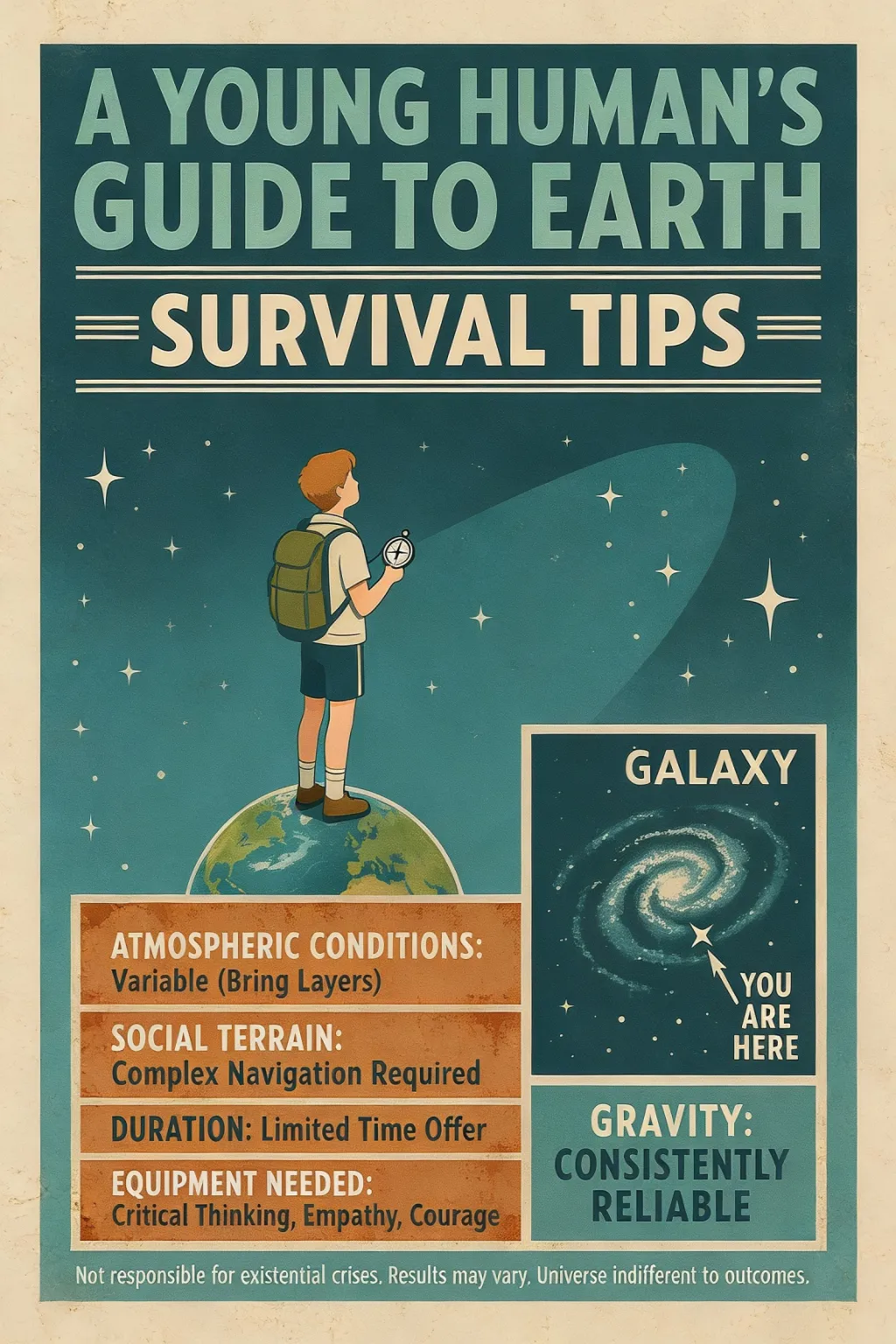
This is your philosophical field manual for not losing your mind whilst being human. Think of it as emergency instructions for a brain that's simultaneously the most sophisticated information-processing system ever evolved and a collection of cognitive biases producing terrible decisions.
The book tackles 50 practical survival tips organised around five key themes: perspective (zooming between geological time and your current drama), social dynamics (understanding hierarchies without becoming enslaved to them), personality patterns (why you're wired differently from your friends and that's fine), time perception (why your brain thinks next week is imaginary), and systems thinking (recognising you're both powerful and cosmically insignificant).
You're essentially a penguin trying to navigate the Sahara using a map of Antarctica. Your brain evolved for African grasslands and tracking 150 people, it's now managing thousands of relationships across digital platforms whilst your social media presence might outlast mountains. The book doesn't promise to eliminate problems, it teaches you to navigate them more effectively whilst accepting that the universe isn't obligated to make sense.
WHY I MADE THIS
I kept watching brilliant young people struggle with challenges that weren't their fault. They were navigating environments that didn't exist a generation ago, with brains designed for completely different circumstances, whilst everyone around them either pretended it was fine or catastrophised without offering useful frameworks.
Parents trying to help but lacking relevant experience. Teachers working with outdated curricula. Peers equally confused but hiding it. And endless online "advice" that was either obvious, wrong, or selling something.
I had time and resources to research what actually helps. Spending years reading peer-reviewed studies across disciplines, identifying patterns that connected planetary and social systems, then distilling it into frameworks that respect intelligence whilst remaining accessible.
It seemed wasteful not to share it.
These aren't my personal wisdom, they're drawn from decades of scientific research across Earth science, psychology, sociology, and systems thinking. I just translated them from academic into actually useful, and connected dots that usually stay separate because disciplines don't talk to each other.
Will this solve everything? No. Life involves unavoidable difficulties. The planet operates according to physics. Humans operate according to psychology. Neither system cares about your preferences.
Will this help? Significantly. Better frameworks enable better decisions. Better decisions produce better outcomes. Better outcomes reduce unnecessary suffering whilst making unavoidable suffering more manageable.
I'm not selling salvation. I'm offering tools.
Use them if they help. Share them if you think they might help others. Evaluate them critically and keep what works.
We're all figuring this out as we go. These just give you a head start on patterns that took me far too long to recognise.
— A. Hughman
(Yes, that's a pseudonym. Yes, it's a pun. No, I'm not sorry.)

The Art of Reframing: Your Mind's Most Powerful Tool
Reframing is the psychological equivalent of tilting a picture frame until the light hits differently. The facts don't change, the situation doesn't vanish but your interpretation and therefore your experience, transforms entirely. It's recognising that the story you tell yourself about what's happening matters as much as what's actually happening.
Why Framing Matters
Your brain doesn't experience reality directly, it experiences your interpretation of reality. When someone ignores your text, you can frame it as rejection or as them being busy. When you fail a test, you can frame it as proof of inadequacy or as information about what to study next. The situation is identical, but one frame leads to despair whilst the other leads to action.
This isn't positive thinking or pretending problems don't exist. It's recognising that most situations contain multiple truths simultaneously. The person who rejected you freed you to find someone better suited. The job you didn't get protected you from a toxic workplace. The friend who drifted away made room for deeper connections. All of these can be true at once.
The Mechanics of Perspective Shift
Reframing works because your emotional response follows your interpretation, not the event itself. Change the frame, and you change the feeling. A challenging project becomes an opportunity to develop skills. Social anxiety becomes excitement, they're physiologically almost identical. Public speaking transforms from threat to gift when you frame it as sharing something valuable rather than being judged.
The key is asking better questions. Instead of "Why did this happen to me?" try "What can this teach me?" Instead of "Why am I like this?" ask "What conditions created this pattern, and can I change them?" The reframe shifts you from victim to scientist, from helpless to curious.
Practical Reframing Techniques
Zoom out in time. Will this matter in five years ? Most daily catastrophes dissolve when viewed from deep time's perspective. That embarrassing moment, that rejection, that failure becomes a tiny blip in your geological timeline.
Zoom out in space. See yourself from orbit, your problems a single point on a vast planet spinning through space. This isn't to diminish your experience but to add context. You're simultaneously important and tiny, your problems real but not universe-ending.
Find the hidden gift. Every difficult person teaches boundary-setting. Every failure teaches resilience. Every loss teaches what truly matters. This doesn't mean welcoming suffering, it means refusing to let it be purely destructive.
When Reframing Becomes Harmful
Reframing isn't gaslighting yourself. Some situations are genuinely bad and need action, not interpretation adjustment. Abuse doesn't become "a learning experience." Injustice doesn't become "character building." The frame needs to serve your wellbeing, not excuse others' harm or your own inaction.
Toxic positivity happens when you use reframing to avoid feeling legitimate emotions. Sometimes you need to sit with sadness, anger, or grief. The reframe comes later, after you've honoured what you feel. Feel it, process it, then ask what frame serves you moving forward.
The Long Game
Mastering reframing means catching yourself mid-interpretation. You notice the frame your mind automatically chose, often the most anxiety-producing one, and you ask: "Is this the only way to see this? What would I tell a friend in this situation?" That pause between event and interpretation is where your power lives.
The frames within frames we've been visualizing represent this beautifully: your personal frame sits within your family frame, within your cultural frame, within your historical moment, within your species' story, within Earth's deep time. Change any level, and the whole picture shifts. You're simultaneously trapped in your current perspective and completely free to choose a different one.
Legal:
Terms of Use
Term & Condition
Payment Method
Privacy Policy